

Keith Zars Pools: A Homeowner’s Guide to Pool Inlets
Pool inlets (also called return inlets or return jets) are the small fittings on your pool walls that send filtered, treated water back into the pool. They’re easy to overlook but they play a huge role in water clarity, comfort, and how hard your equipment must work.
At Keith Zars Pools, we take inlets seriously because great circulation is one of the biggest “quiet upgrades” you can build into a pool.
What pool inlets do (and why they matter)
After water leaves your pool through the skimmer and main drain, it travels through your pump and filter (and often a heater, chlorinator, or salt system). Pool inlets are the “finish line” of that circulation loop.
When your inlets are positioned and adjusted correctly, they help:
- Push debris toward the skimmer so it can be removed
- Prevent “dead spots” where algae and cloudy water love to start
- Distribute heat and chemicals more evenly
- Improve overall circulation so your system runs more efficiently
The Keith Zars Difference: inlet placement that improves performance
Not all inlets are installed the same.
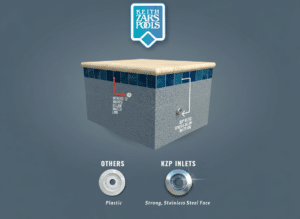
Industry standard placement is around 12 inches below the waterline. At Keith Zars Pools, our inlets are typically positioned about 18 inches below the waterline, a detail designed to help improve overall circulation and support more even chemical and heat distribution.
That deeper placement can also help reduce stagnant zones near the surface and keep water moving more consistently throughout the pool.
The Keith Zars Difference: performance and aesthetics
Inlets do a serious job but they shouldn’t look like an afterthought.
Our inlets are finished with a stainless steel face ring that pairs cleanly with your pool’s materials and overall design. Many pools use a traditional white plastic inlet, which can stand out against tile, plaster, and premium finishes.
Bottom line: you get the circulation benefits you want and a detail that looks right at home in a luxury pool.
Benefits of Keith Zars Pools inlets
Here’s what that approach is designed to deliver:
- Enhances overall water circulation throughout the pool
- Ensures even and efficient distribution of pool chemicals
- Helps prevent algae growth and buildup
- Reduces stagnant water zones for cleaner, healthier water
- Promotes consistent and uniform heat distribution
Keith Zars Pools inlet facts (quick hits)
A few details homeowners like to know:
- We typically install 6 to 8 (or more) inlets per pool for strong circulation performance
- Each inlet is positioned about 18 inches below the waterline to help improve chemical distribution
- Deeper inlet placement can support more even and efficient heating
- Every inlet installation includes in-depth water pressure testing
The Keith Zars Pools inlet process (4 steps)
Inlets aren’t just about where they go, they’re about how they’re installed. Here’s a simplified look at our inlet process:
- Apply purple primer: We apply Weld‑On P‑68 Purple Primer around each inlet to properly prep the PVC pipe.
- Apply Weld‑On 747 glue: Weld‑On 747 Glue is used to ensure maximum pipe adhesion and to meet or exceed ASTM D2564 (industry standard).
- Install a red water stop: The red water stop acts as a double-security measure to help avoid water leaks.
- Hydraulic water plug: A hydraulic water plug uses a circular packing material around the inlet and pool piping to promote a strong bond between the PVC piping and the pool shell, helping prevent water leaks.
Where you’ll find inlets
Most pools have multiple inlets spaced around the perimeter. Some pools also have dedicated returns for:
- Spas
- Water features (sheer descents, waterfalls, bubblers)
- In-floor cleaning systems
The parts of a pool inlet (quick breakdown)
Depending on your pool, your return assembly may include:
- Return fitting (eyeball): The directional nozzle you can aim
- Face ring / escutcheon: The trim piece you see on the wall
- Wall fitting: The threaded body behind the wall
- O-rings / gaskets: Seals that prevent leaks
If you’ve ever noticed a return that won’t “aim” anymore, feels loose, or drips, it’s usually a worn fitting or gasket, not a major repair, but it should be addressed.
How to aim your inlets for better circulation
A simple adjustment can make a noticeable difference.
General rule of thumb
Aim your inlets so they create a gentle, consistent circular flow around the pool, usually pushing water toward the skimmer.
Typical aiming tips
- Angle the return slightly downward (helps mix chemicals and reduces surface “stagnation”)
- Angle it slightly to the side (creates a slow “lazy river” effect)
- Avoid aiming straight up (can cause splash-out and wasted circulation)
If your pool has a spa spillway or water feature, you may need a different balance—enough return flow for circulation, but not so much that it disrupts skimming.
Common inlet problems (and what they’re telling you)
Here are a few issues we see often in South Central Texas pools:
1) Weak flow from one inlet
Possible causes:
- A partially closed valve
- Debris in the return line
- A clogged filter or dirty pump basket
- A return fitting that’s blocked or scaled
2) Cloudy water even though chemicals look “fine”
Often a circulation issue:
- Returns aren’t aimed to eliminate dead spots
- Not enough run time for your pool size
- Filter needs cleaning/backwashing
3) Leaking around the return fitting
Possible causes:
- Worn gasket or cracked fitting
- Loose wall fitting
- Aging plaster/tile interface around the return
Leaks should be addressed quickly; small drips can become bigger repairs if water migrates behind the finish.
Inlets, remodels, and upgrades: what homeowners should consider
If you’re remodeling your pool or building a new one return placement is one of those “behind-the-scenes” details that pays off for years.
A thoughtful inlet plan can:
- Improve circulation in tanning ledges, benches, and deep ends
- Reduce problem areas where algae tends to start
- Support better heating performance
- Pair well with modern automation, variable-speed pumps, and salt systems
At Keith Zars Pools, we look at the whole backyard system, pool shape, sun exposure, wind patterns, water features, and how you use the space, so your circulation works with your design, not against it.
Quick homeowner checklist
If you want to do a fast inlet check today:
- Turn the system on and look for steady flow from each return.
- Aim returns to create a consistent circular surface movement.
- Watch where leaves are collected, those are your likely dead spots.
- If one return is weak, check baskets and filter pressure first.
- If you see drips, cracks, or loose fittings, schedule a service visit.
Need help with circulation or a return repair?
Whether you’re troubleshooting cloudy water, dealing with a leaky return fitting, or planning a remodel, our team can help you get your system dialed in, so your pool stays clear, comfortable, and ready for memory-making.